
Animal Spirits.
Humans have always been political animals, often in the worst sense of the term. That is precisely why only the best politics can restrain and govern their instincts.

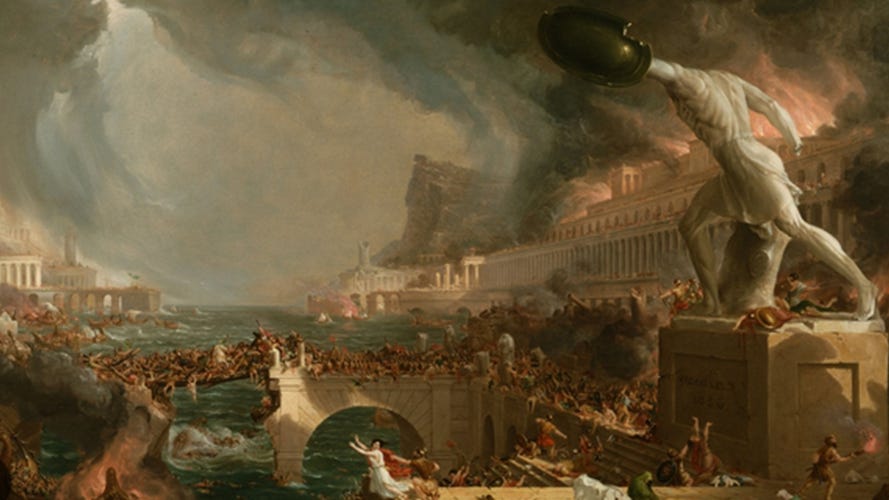
A modern state is a vast and inherently fragile construction. It is not a moral community, nor a natural organism, but a negotiated space in which fundamentally self-interested individuals coexist. People do not gather because they trust one another or share a spontaneous sense of solidarity; they gather because they understand, often implicitly, that coordination is the most efficient mechanism for maximizing individual welfare.
The legitimacy of institutions, in this sense, rests less on shared values than on performance. Social order is sustained as long as the system reliably delivers predictable benefits: security, income, services, opportunity. Stability emerges not from harmony, but from the regular satisfaction of dispersed interests, carefully balanced to prevent any single tension from becoming dominant.
This equilibrium becomes visible only when it breaks. Financial and economic crises act as moments of revelation, interrupting long phases of diffuse and anesthetizing prosperity.
When resources contract, the hierarchy of needs reasserts itself with clarity. What had been abstract, growth, rights, long-term planning, gives way to the immediacy of survival. In these conditions, the true nature of human behavior is exposed: not inherently malicious, but driven by scarcity, fear, and urgency. The collective utility function becomes progressively harder to satisfy, and impulses shaped by evolutionary pressure, such as competition, territoriality, aggression, resurface. Citizens experience anxiety, anger, and resentment not as ideological positions, but as physiological responses to perceived deprivation.
The cumulative effect of these reactions is decisive. This outcome is not accidental, but structural. In a zero-sum social environment, the satisfaction of one need increasingly corresponds to the frustration of another. Individual actions, each rational in isolation, shift the collective center of gravity toward a bad equilibrium.
Redistribution becomes conflictual, compromise unstable, trust costly. Under the pressure of forces as ancient as life itself, the public edifice begins to erode. Institutions adapt, but adaptation often means simplification: fewer safeguards, sharper hierarchies, darker incentives. The state does not collapse; it corrodes, bends, and reshapes itself.
In the end, it transforms, to manage urgency, contain fear, and respond to the most primitive demands of collective survival.
Marketszoon clearly lays out the crisis of the interconnected world we live in. The people of means will decide by individual moves in the financial positions held in markets and board rooms around the world the future of civilization.
Will the anesthetizing prosperity they perceive as their protection be the controlling force or will their connections to the human family on which they depend determine their moves in this crisis?
The transformation spoken of at the end of this article is hopefully the silver lining that will allow survival of our human family…to survive again…
Grim, but true.